Black Friday week

Black Friday week

📄 Digital book in PDF · read it on your phone or print it

Inverter and Battery Backup in Drawings Size Every Job in 6 Steps, Always in the Same Order

Size the load, sort the circuits, choose the battery: the 6-step method, the three layouts and safe isolation, one topic per page. The drawing first, then the numbers and checks to remember. 64 illustrated pages.

START PLANNING THIS WAY

🔒 Secure checkout · PDF by email · 30-day guarantee

Every topic, its own pageEach layout, battery and sizing step drawn, with the explanation alongside
64 illustrated pages8 parts, from watts and kilowatt-hours to the final self-check
Up-to-date sourcesSANS 10142-1, SANS 10142-1-2 and the Electrical Installation Regulations
PDF by emailFormat

Look Inside the Book

Every page has one large drawing and a box with the numbers, steps and checks you need to know:

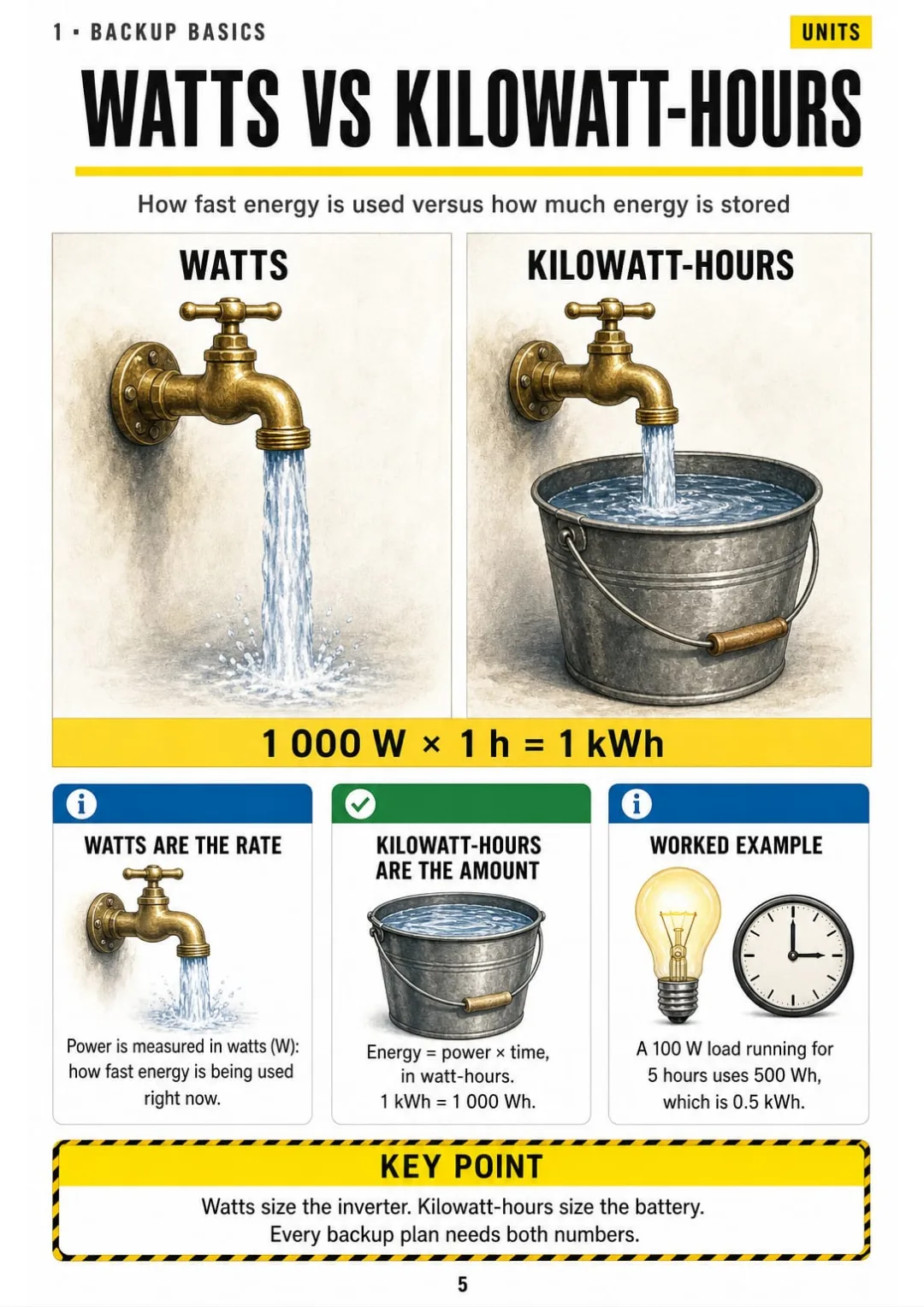
1 000 W running for 1 hour = 1 kWh: the two numbers every backup plan starts with
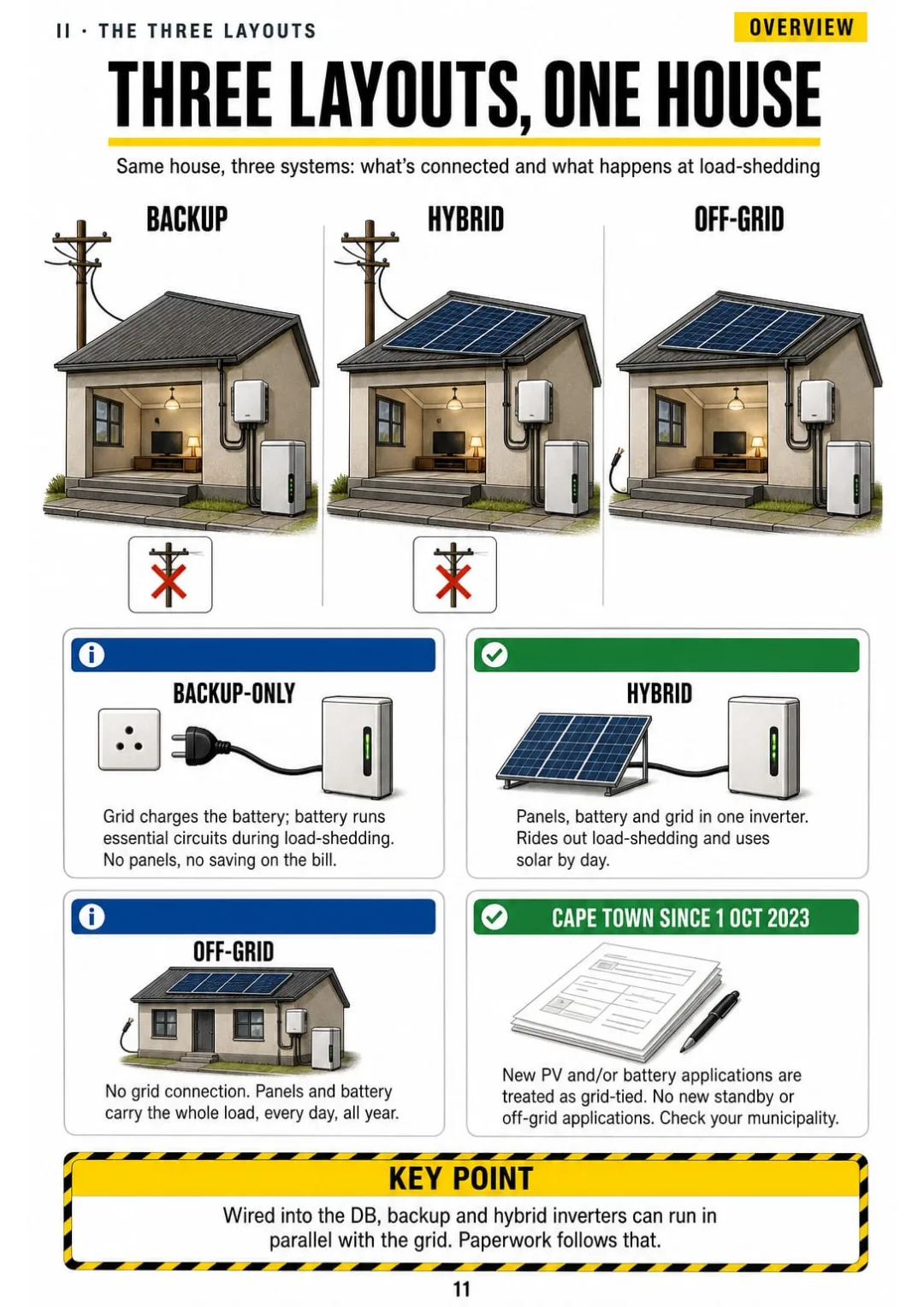
Three layouts on one house: what each runs when the grid goes off
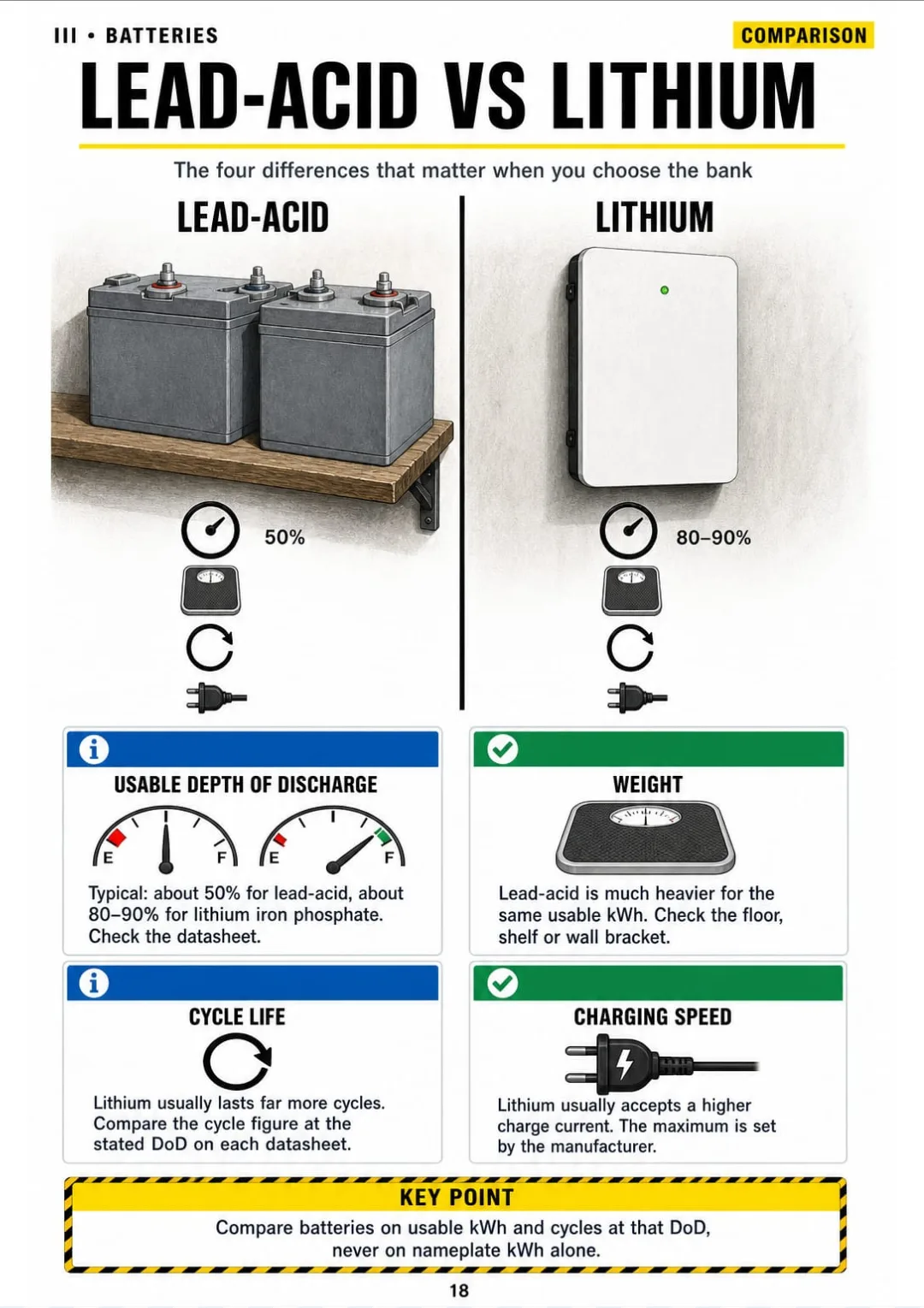
Lead-acid about 50% usable, lithium about 80–90%: typical, check the datasheet
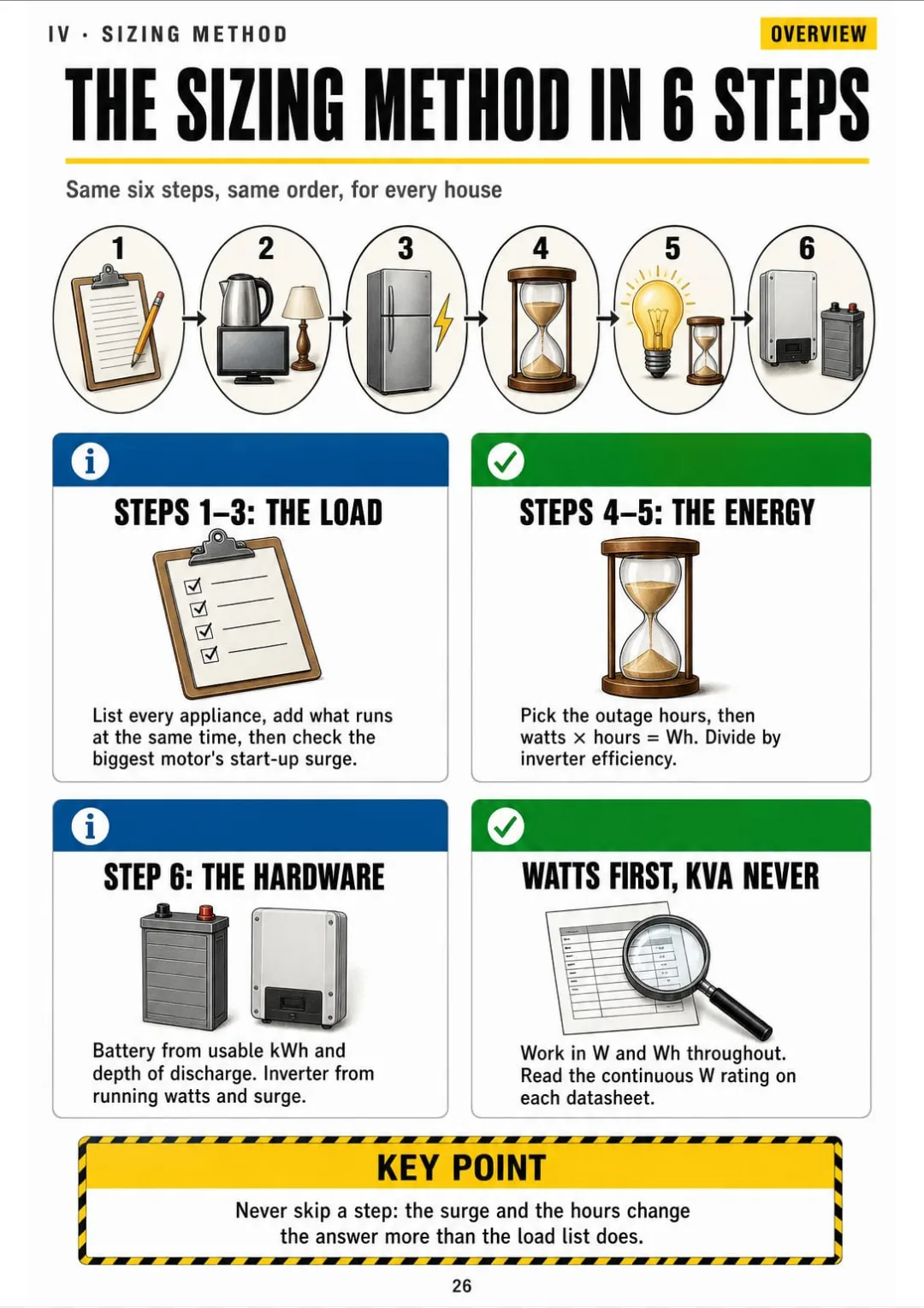
Load list → running watts → surge → hours → kWh → battery and inverter
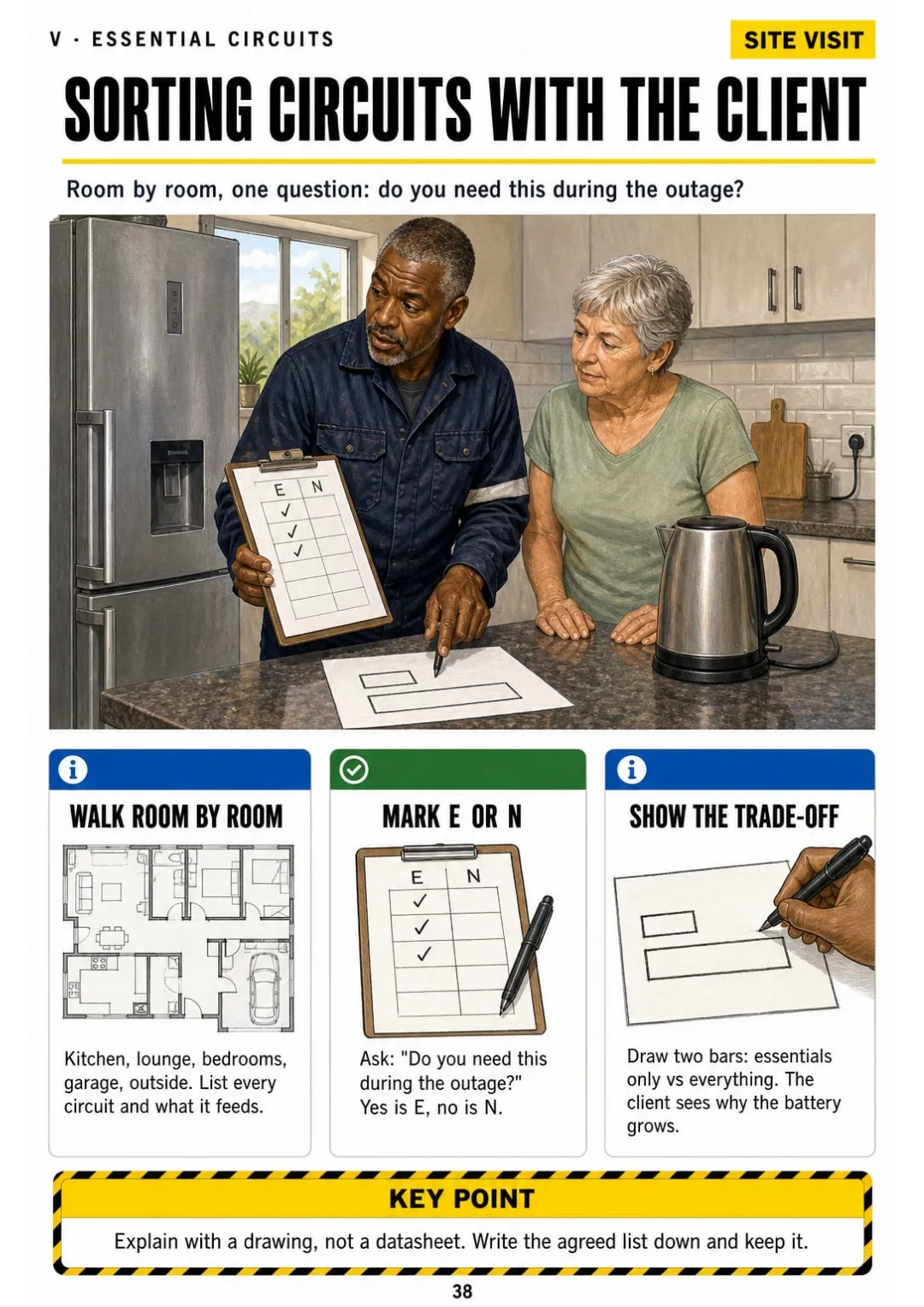
Room by room, mark E or N, and show the client the trade-off on paper.
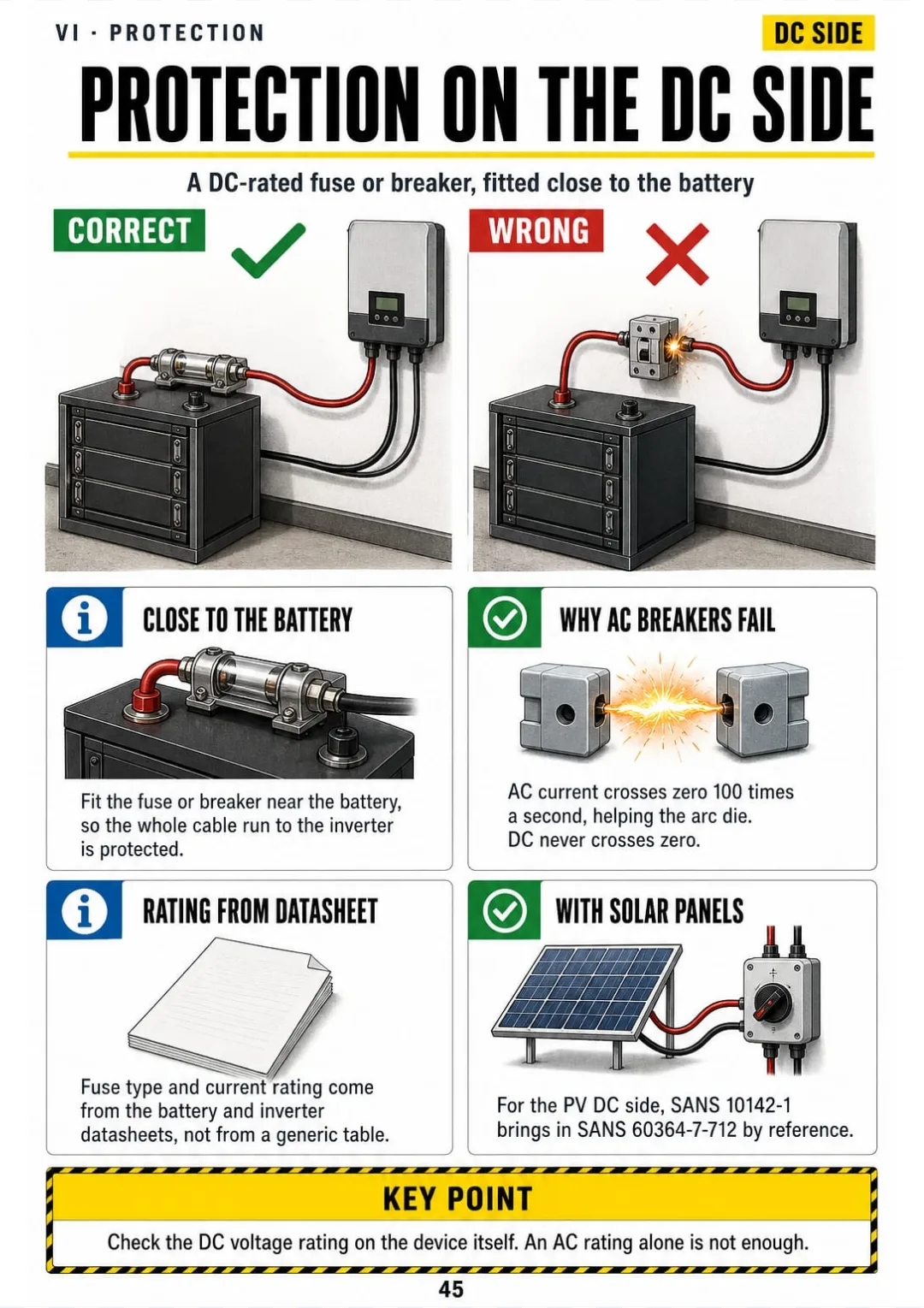
DC protection: a DC-rated fuse or breaker beside the battery, because a DC arc does not self-extinguish
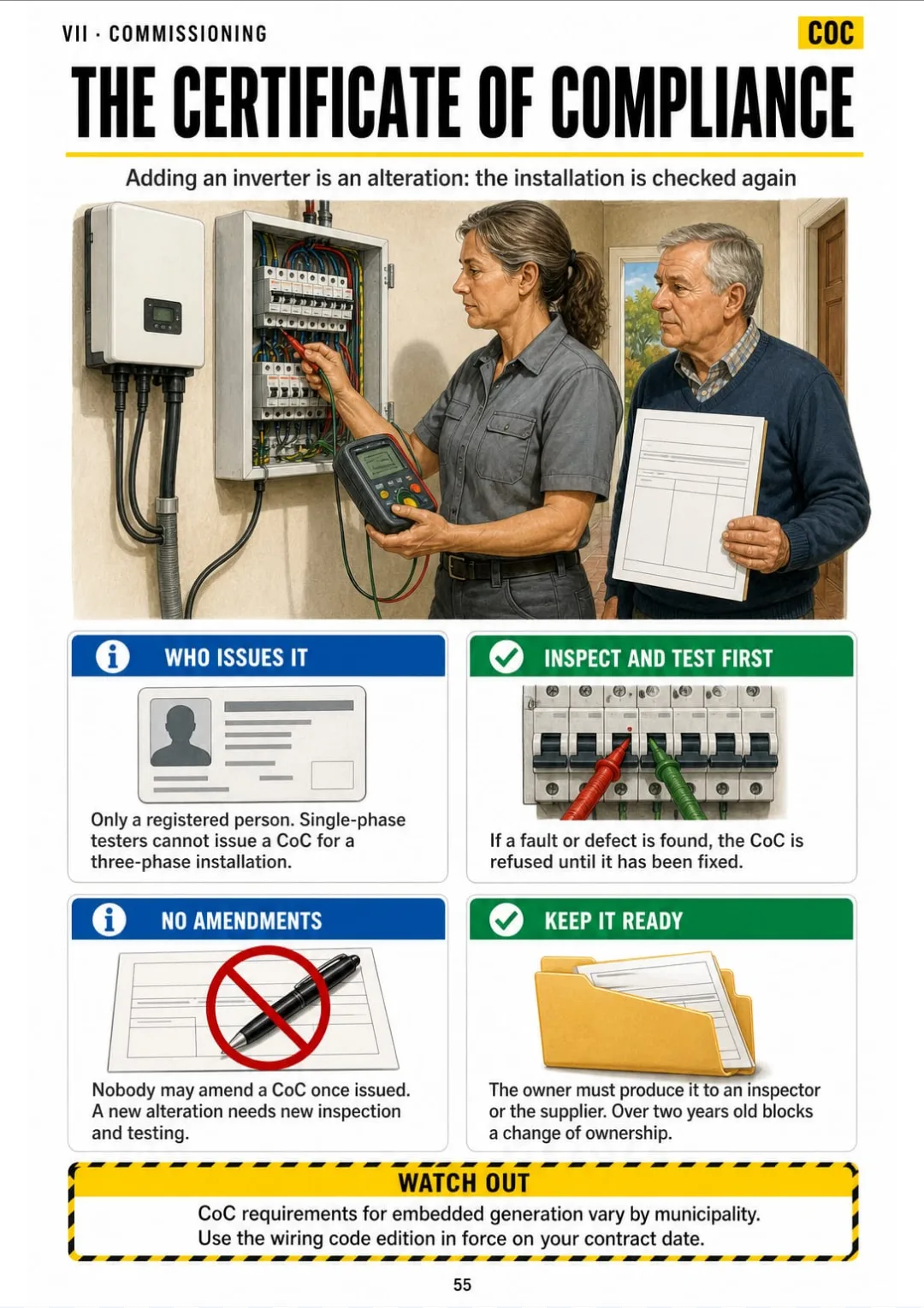
Only a registered person issues a CoC, after inspecting and testing, and nobody may amend it.
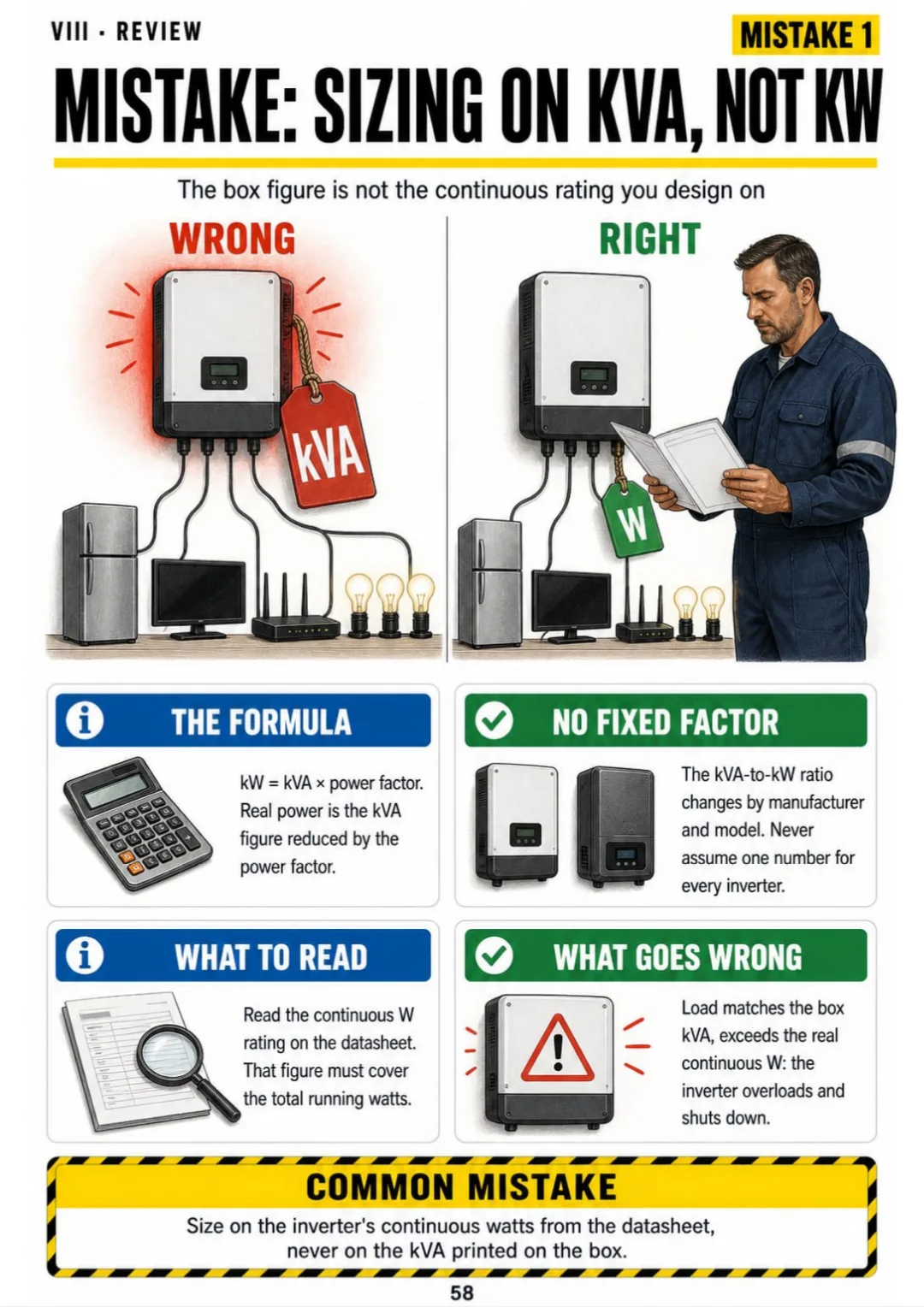
Same job sized twice: on kVA it overloads, on continuous W it runs.

Swipe to see more →

These are real pages from the book. The table of contents is the full one: 8 parts and 60 topics.

The Problem Isn't You. It's How It Was Explained.

You're in a client's garage, next to an old lead-acid bank and a new lithium proposal. They ask you straight out: why does the lithium one run longer if both labels say 5 kWh?

The answer is out there somewhere, spread over three datasheets and a forum thread. Depth of discharge, cycle life and usable capacity are explained in paragraphs, each brand with its own terms, so nothing joins up when the client is waiting.

Lead-acid about 50% usable, lithium about 80–90%: typical, check the datasheet

In the book, that's one page. Lead-acid and lithium drawn side by side: the same 5 kWh label, about half usable on one, about 80–90% on the other, with the datasheet check marked on the drawing.

The rest works the same way: the three layouts, the 6-step sizing method, essential circuits, the safe isolation sequence and the pre-start checklist. Each one has its own page.

You understand it, you sketch it for the client on the back of a job card, and you only open the datasheet to check that model's figures.

COMPARE FOR YOURSELF

The Same Topic, Two Ways to Learn It

THIS
  • The manual: line after line
  • Layouts explained only in words
  • You get to site still unsure
A backup-only system comprises an inverter-charger connected between the supply and a designated set of essential circuits, deriving its charging energy exclusively from the utility supply, whereas a hybrid system additionally incorporates a photovoltaic input, permitting the battery to be charged and the loads to be supplied from the array, subject to the applicable embedded generation requirements. An off-grid system, by contrast, operates without any connection to the utility network, so that generation, storage and consumption must be balanced independently at all times, under all seasonal conditions.
FOR THIS
  • Each layout in one drawing
  • What runs on backup, in a box
  • You see it and you get it
Three layouts on one house: what each runs when the grid goes off
CONTENTS

Take a Look at the 8 Parts and 60 Topics

Backup basics, the three layouts, batteries compared, the sizing method, essential circuits and changeover, protection and safe isolation, commissioning and handover, and common mistakes: 64 pages, all illustrated

IBackup Basics · pp. 5-10
  1. Watts vs kilowatt-hours
  2. kVA vs kW on the nameplate
  3. Continuous vs surge power
  4. AC side and DC side
  5. What an inverter actually does
  6. Load-shedding slots and backup hours
IIThe Three Layouts · pp. 11-17
  1. Backup, hybrid and off-grid side by side
  2. The backup-only layout
  3. The hybrid layout
  4. The off-grid layout
  5. Grid-tied with no export
  6. Inverter UPS mode and switchover time
  7. Which layout for which client
IIIBatteries Compared · pp. 18-25
  1. Lead-acid vs lithium on one page
  2. Depth of discharge drawn
  3. Volts × amp-hours = watt-hours
  4. Series and parallel
  5. Lithium and the BMS
  6. Lead-acid types: flooded, AGM, gel
  7. Battery placement and temperature
  8. Charge rate and recharge time
IVThe Sizing Method · pp. 26-35
  1. The sizing method in 6 steps
  2. Step 1: the load list
  3. Typical household watts
  4. Step 2: total running watts
  5. Step 3: the surge check
  6. Step 4: hours of backup
  7. Step 5: energy in kWh
  8. Step 6: choosing the battery
  9. Choosing the inverter size
  10. Worked home: a 3-bedroom house
VEssential Circuits and Changeover · pp. 36-43
  1. Essential vs non-essential circuits
  2. Why the geyser and stove stay off
  3. Sorting circuits with the client
  4. Splitting the DB
  5. Manual changeover switch
  6. Automatic transfer inside the inverter
  7. The maintenance bypass
  8. Neutral and earth on backup
VIProtection and Safe Isolation · pp. 44-51
  1. Protection on the AC side
  2. Protection on the DC side
  3. DC cable sizing in principle
  4. Earthing the inverter and frame
  5. Surge protection
  6. The safe isolation sequence
  7. Prove dead before you touch
  8. Labels and warning signs
VIICommissioning and Handover · pp. 52-57
  1. Pre-start checklist
  2. Setting up the inverter
  3. The grid-off test
  4. The Certificate of Compliance
  5. Registering with the municipality
  6. Explaining the system to the client
VIIIReview and Common Mistakes · pp. 58-64
  1. Mistake: sizing on kVA instead of kW
  2. Mistake: using nameplate kWh as usable kWh
  3. Mistake: forgetting the surge
  4. Mistake: the whole house on backup
  5. Mistake: no recharge window
  6. The whole method on one page
  7. Final self-check: 10 questions

One Page, One Topic, All Clear

Think of it this way:

The client hands you a list: fridge, TV, router, gate motor, a few lights and the kettle "just in case". They want to know how long it will all run when the power goes off.

You open the sizing page and the six steps are drawn in order: load list, running watts, surge, hours, kWh, then battery and inverter, with a 3-bedroom house worked through.

Room by room, mark E or N, and show the client the trade-off on paper.

The same with the three layouts, lead-acid vs lithium, essential circuits, AC and DC protection and the grid-off test: each one on its own page.

Inverter & Battery Backup Illustrated is 8 parts and 60 topics, all drawn, ending with five frequent mistakes, the whole method on one page and a 10-question self-check.

What you see drawn, you don't have to memorize.

What's Inside Inverter & Battery Backup Illustrated:

Ipp. 5-10

Backup Basics

Watts vs kWh, kVA vs kW, continuous vs surge power, the AC and DC side, what an inverter actually does and backup hours per load-shedding slot.

IIpp. 11-17

The Three Layouts

Backup, hybrid and off-grid side by side, each layout on its own, grid-tied with no export, UPS mode and switchover time, and which layout suits which client.

IIIpp. 18-25

Batteries Compared

Lead-acid vs lithium, depth of discharge, volts × amp-hours, series and parallel, the BMS, flooded, AGM and gel, placement, temperature and recharge time.

IVpp. 26-35

The Sizing Method

The 6-step sizing method, the load list, typical household watts, the surge check, hours of backup, kWh, choosing the battery and inverter, and a worked 3-bedroom house.

Vpp. 36-43

Essential Circuits and Changeover

Essential vs non-essential circuits, why the geyser and stove stay off, sorting circuits with the client, splitting the DB, manual and automatic changeover, the bypass, neutral and earth.

VIpp. 44-51

Protection and Safe Isolation

AC and DC protection, DC cable sizing in principle, earthing the inverter and frame, surge protection, the safe isolation sequence, proving dead and labels.

VIIpp. 52-57

Commissioning and Handover

The pre-start checklist, setting up the inverter, the grid-off test, the Certificate of Compliance, registering with the municipality and explaining the system to the client.

VIIIpp. 58-64

Review and Common Mistakes

Five frequent mistakes, from kVA instead of kW to no recharge window, the whole method on one page and a 10-question self-check.

At the end of the book: Five frequent mistakes, the whole method on one page and a 10-question self-check.
Plus: 2 Free Books

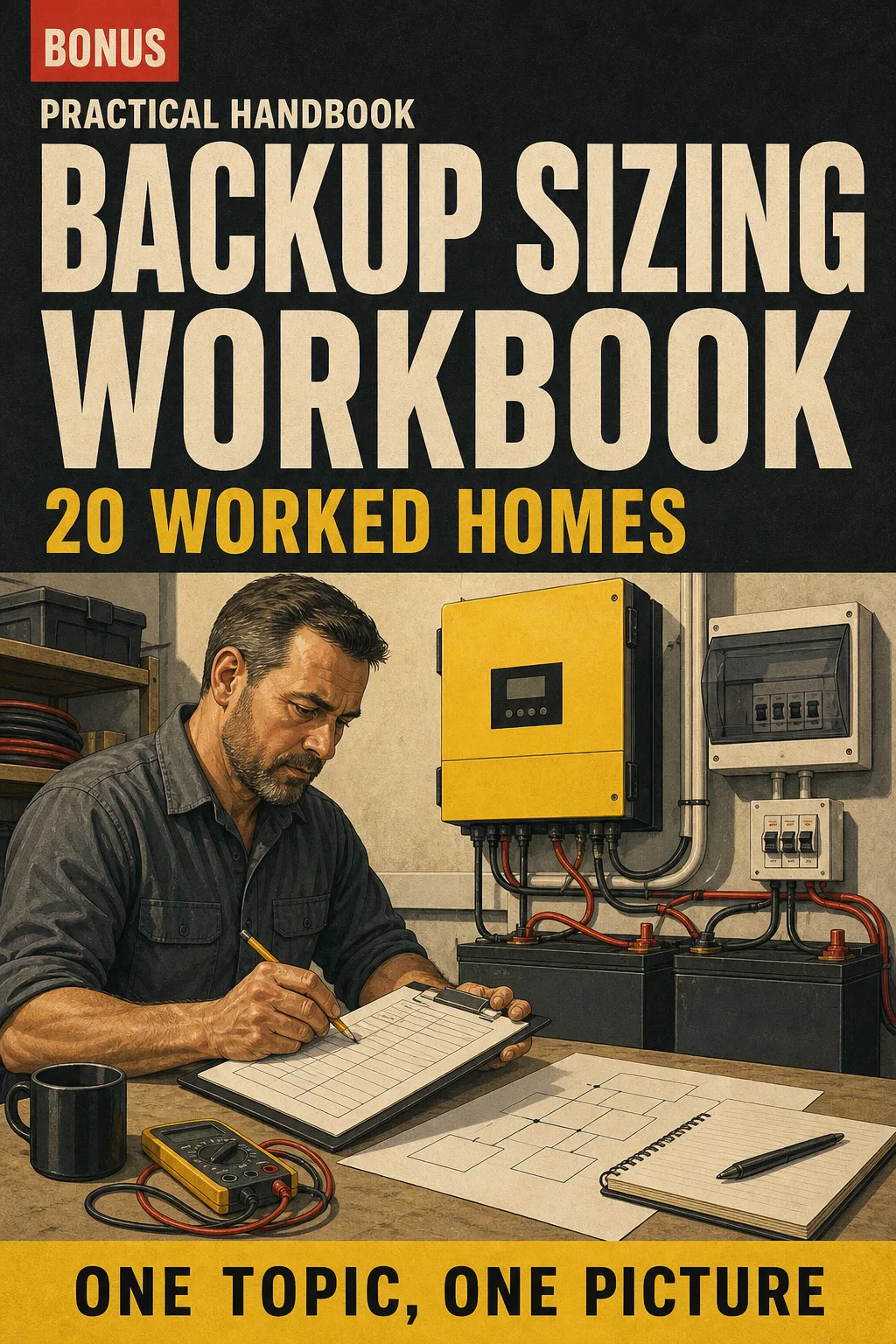
Backup Sizing Workbook: 20 Worked Homes

BONUS 1: «Backup Sizing Workbook: 20 Worked Homes»

Value on its own: US$ 17.90

Practise the sizing method on 20 real household loads, from a flat to a family home, and check your watts, kWh and hours of backup against the worked answers.

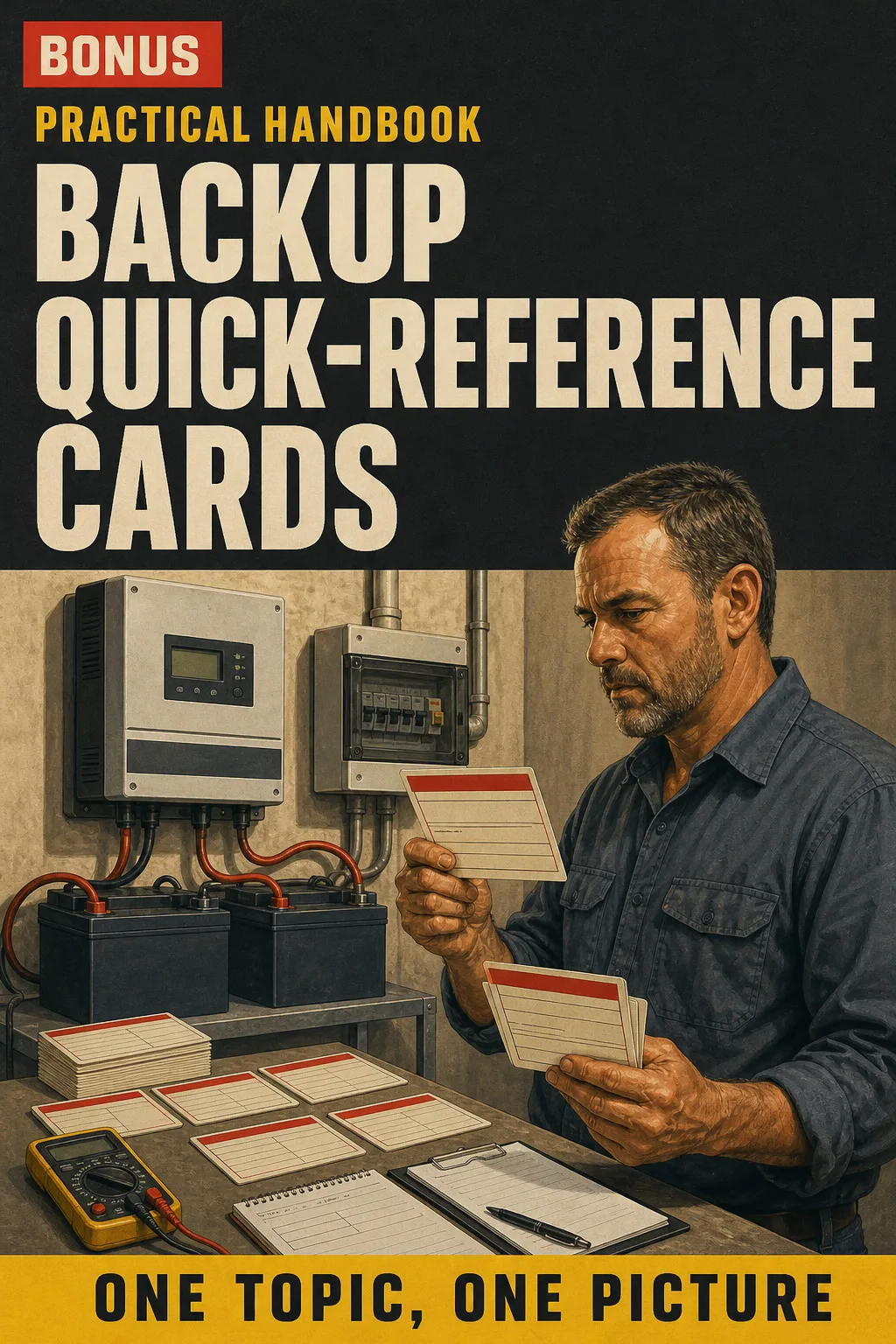
Backup Quick-Reference Cards

BONUS 2: «Backup Quick-Reference Cards»

Value on its own: US$ 14.90

The layouts, battery comparison, switch-off order and the most common mistakes on printable cards you can keep in the bakkie or on the DB door.

Black Friday week · ends 30 Nov

Inverter & Battery Backup Illustrated with 2 Free Books

  • Inverter & Battery Backup Illustrated: 64 illustrated pagesUS$ 63
  • BONUS 1: Backup Sizing Workbook: 20 Worked HomesUS$ 17.90
  • BONUS 2: Backup Quick-Reference CardsUS$ 14.90
  • High-resolution PDF to printIncluded
Total value US$ 95.80
BLACK FRIDAY PRICE:
US$ 27
You save US$ 68.80
YES, I WANT INVERTER & BATTERY BACKUP ILLUSTRATED FOR US$ 27

📄 This is a digital PDF book sent to your email: nothing is printed or shipped.

Secure purchaseEncrypted payment30-day guarantee

PDF by email: We email you Inverter & Battery Backup Illustrated as a PDF, together with the two free books. It's a single payment: no installments, no extra charges.

Who This Book Is For

You're adding backup to your installs

You're adding backup to your installs

The three layouts and the battery types drawn side by side, so you know which system fits which house before you quote.

You've got a site survey this week

You've got a site survey this week

The 6-step sizing method and the circuit sorting page to take along, so you size the load in front of the client and show them why.

You're choosing a system for your home

You're choosing a system for your home

What a battery really runs, and for how long, drawn page by page, so you understand what you're being offered before you decide.

Everything You Get Today

US$ 95.80US$ 27
YES, I WANT INVERTER & BATTERY BACKUP ILLUSTRATED FOR US$ 27

📄 This is a digital PDF book sent to your email: nothing is printed or shipped.

30DAYS
GUARANTEE

30-Day Guarantee

Try Inverter & Battery Backup Illustrated for 30 days, bonus books included.

We refund everything if the file won't open, if the book isn't what you see here, if you were charged twice or if the email doesn't arrive. Just email us.

You pay once. No subscriptions.

Frequently Asked Questions

Is it for me if I already do domestic installs and I'm adding inverters?

Yes. It doesn't teach wiring from zero: it gives you a fixed order for backup jobs, from the load list to handover, drawn so you can also show it to the client. It isn't tied to one brand: each inverter setting is explained by what it does (battery type, charge current, cut-off voltage), so you can find it in any brand's menu and check it against that model's manual. Homeowners choosing a system can follow it too.

Where does the content come from?

It's written for South Africa against SANS 10142-1 and SANS 10142-1-2, read with the Electrical Installation Regulations, in metric units. Battery and inverter figures are typical values: always check the manufacturer's datasheet and the current edition of the standard.

Is it official material?

No. It's an independent illustrated guide. It isn't published, approved or endorsed by the SABS, the Department of Employment and Labour or any manufacturer, and it doesn't reproduce the text of any standard.

Does it replace training or a registered electrician?

No. It's study and planning material, and it doesn't give you a certificate, a qualification or a Certificate of Compliance. Connecting an inverter, splitting the DB, earthing and isolation are work for a qualified, registered person.

Are the practice questions official questions?

No. The 10-question self-check and the 20 worked homes in the workbook are written for this book. They aren't taken from any official exam or assessment.

When and how does it arrive?

As a PDF by email, to the address you enter at checkout. The two bonus books come as PDFs by email too.

Do I have to pay every month?

No. It's a one-off payment, with no subscription.

Can I have it on paper?

It's a PDF, not a printed book, but it's laid out to print at home or at a print shop, so you can keep a copy in the vehicle or on site.

How does the refund work?

You have 30 days. We refund everything if the file won't open, if the book isn't what you see on this page, if you were charged twice or if the email doesn't arrive: just email us.

Before You Close This Page

No more rereading datasheets that don't stick.

The layouts and the sizing steps are drawn: you see them and you've got it.

You arrive on site knowing where everything is.

Drawings make studying faster.

The book is right below.

One-time payment: US$ 27 · Guarantee: 30 days · PDF by email

YES, I WANT INVERTER & BATTERY BACKUP ILLUSTRATED FOR US$ 27

📄 This is a digital PDF book sent to your email: nothing is printed or shipped.